Alumni Introduction

Kabalano Thabang Rampa (Chinese name: Xiaohu) is an alumnus from Botswana. He earned his MBA taught in English at Nanchang University, class of 2012. In 2014, he founded NADRA Global, focusing on China-Africa cross-border trade. Regarding China as his second home, he draws on the knowledge and global vision gained during his studies at Nanchang University to continuously advance China-Africa economic and trade cooperation and youth exchanges. He is a young practitioner bridging China and Africa. Now let us hear about his study experience at Nanchang University and his career journey.
Question 1: Please briefly introduce yourself.
My name is Kabalano Xiaohu Rampa, and my Chinese name is Xiaohu. I come from Botswana, a country in the centre of Southern Africa. I pursued the English-taught MBA programme at Nanchang University and graduated in 2013. My time at Nanchang University ranks among the best years of my life. This experience greatly shaped my worldview and allowed me to witness China’s development first-hand.
I specialise in international trade economics. Currently, I serve as the Regional Director of NADRA Global in Botswana. We believe trade should drive local development in the regions involved: benefiting employees and customers first, then the wider community and region. Positive change means more than numerical growth; it also means boosting economic vitality and mutual learning between different cultures. That is the true meaning of trade — connecting people from all over the world.
Question 2: Why did you choose to study in China, and why Nanchang University?
At that time, I was awarded the Chinese Government Scholarship for Botswana students. I remember I was working at a financial firm in Botswana. Botswana is a small country with a population of around two million, yet young people like us were eager to see the wider world, and China was the perfect place to explore and learn.
I spotted information about the Chinese Government Scholarship released by the Chinese Embassy in our local newspaper and submitted my application. The embassy did not advise on university selection; instead, they asked me to choose my intended major or degree type. The field I selected matched Nanchang University’s programme, so I came here. Before arriving in China, I read about Nanchang and was fascinated by its lakes, cuisine and history. After I actually came, I received far more surprises than I expected.
Question 3: As an international student in China, did you encounter difficulties in language, culture or other areas? How did you overcome them?
Like all international students coming to China, language was one of my biggest challenges at the beginning. After enrolment, the university arranged Chinese language courses for us, and teachers guided us to adapt to campus life. The university also organised many exchange activities between Chinese and international students. Taking part in these activities helped me learn faster, more easily and more enjoyably than studying only in classrooms.
Besides, I love spicy food, and Nanchang is famous for its spicy cuisine. I fell in love with local food right away. I still remember the barbecue along the backstreet and the cafeteria stall I often visited after class. During my first few months in China, I hardly missed Western food at all because I loved Chinese food so much.
Question 4: What is your most unforgettable memory from your studies at Nanchang University?
This deserves a longer answer, for it paved the way for my post-graduation career, and everything started at Nanchang University. That is why I cherish and am grateful to this university so deeply.
Our dormitory and classroom buildings overlooked a beautiful lake. The lake view inspired me to study hard, dare to dream and stay ambitious, always keeping an eye on the future. In class, teachers encouraged us to ask questions actively. After each class, we often stayed in the classroom and kept discussing heatedly. One of my favourite teachers was Professor Wang Hongping, who taught economics. His lectures were brilliant. When we struggled to understand certain concepts, we kept asking questions until we fully grasped them. Sometimes we remained in the classroom discussing even at lunchtime. Those days were wonderful.
Question 5: What was your biggest gain and growth while studying at Nanchang University?
One incident profoundly changed the course of my life. During a holiday, I went to the Chinese Embassy in Beijing to renew my passport and had a conversation with the Ambassador of Botswana to China. The ambassador asked about my plans after graduation. I told him I might return home to look for a job. He mentioned that many Botswana students graduating from Chinese universities struggled to find jobs back home, and he had been thinking of ways to solve this problem.
Back in my dormitory, I began to design a project to help graduating international students in China secure jobs and build professional networks. From this idea, I launched a platform called BONA CHINA (Botswana National Alliance China Conference). It connects graduating African students studying in China with Chinese enterprises and organisations operating in Botswana and other African countries, creating internship and graduate job opportunities for them.
I shared this idea with my counsellor, Mr. Song Wenjie. The university fully supported me and helped source a venue for the conference. Interestingly, the venue ended up being the International Academic Exchange Centre near our dormitory. The event attracted international students from Nanchang and across China, as well as many international enterprises engaged in trade across Africa. It became a platform for students to meet companies, explore career opportunities and build valuable professional connections. It was a huge milestone for me, as I had never organised anything like this before. We acted because we saw the real need to help international students transition from their studies in China to professional careers.
The Ambassador of Botswana to China travelled all the way from Beijing with a delegation to attend the conference. This experience also earned me an internship opportunity in Shanghai — something that would hardly have happened without the conference, and the conference would never have taken place without Nanchang University. It taught me to identify opportunities and problems, and to solve issues that matter not just to myself, but to communities and many others, creating impact even at a broader level. That lesson influenced me most.
Question 6: 2026 marks the 20th anniversary of the School of International Education, Nanchang University. As an alumnus, how do you view the school’s role in people-to-people and educational exchanges between China and foreign countries? What expectations do you have for its future?
I think Nanchang University is an outstanding university. More importantly, it has enormous potential to serve as a bridge connecting many young African students and professionals like me.
I hope Nanchang University can raise its profile and influence across Africa and become a platform for closer collaboration in education, research and people-to-people exchanges between China and Africa. When I organised my conference, I met many international students from other universities. After coming to Nanchang University, they were amazed by the support the university offers international learners. There are countless universities in China, so standing out is not easy. Yet I truly believe Nanchang University has achieved that, and it has the potential to accomplish even more in advancing China-Africa cooperation in education, research and cultural exchange.
I sincerely hope Nanchang University will continue to be an institution where more international students thrive. I hope more African professionals and students will carry fond memories of this university just like I do.
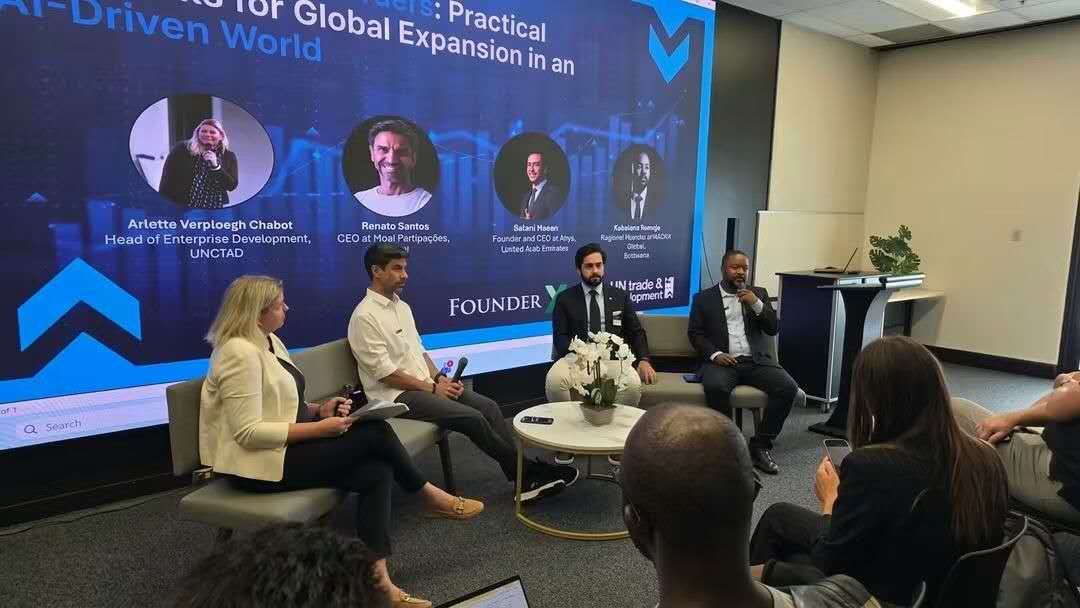
I still remember a teacher at Nanchang University once told me: when you are young, your experiences shape who you become. It is not hard to see your potential; what truly shapes you is your environment and how you spend your student years. I did not fully understand this at that time, but I have grasped its meaning nearly 20 years later. Studying at this remarkable university, meeting these incredible teachers and receiving this high-quality education profoundly changed who I am today and set me on an unexpected path. Just last week, I delivered a speech at one of the world’s top venture capital funds in Silicon Valley. Next month, I will attend one of the world’s largest conferences. None of this would have been possible without the solid foundation and excellent education I received at Nanchang University.
Finally, happy 20th anniversary, IEC!


